An FPSO (Floating Production, Storage, and Offloading unit) is primarily used for offshore oil field development. It receives a mixture of oil, gas, and water from subsea wells, separates, processes, and meters the mixture on board, stores the qualified crude oil in the vessel’s hold, and finally transports it offsite via shuttle tankers.
These units are generally used in deepwater fields, marginal fields, and offshore projects far from onshore pipeline networks. An FPSO is not merely a vessel; it is more like a production plant floating on the sea. Therefore, it imposes high requirements on the hull structure, topside modules, piping systems, control systems, and quality traceability.
I. FPSOs in Brazil’s Subsaline Oil Fields
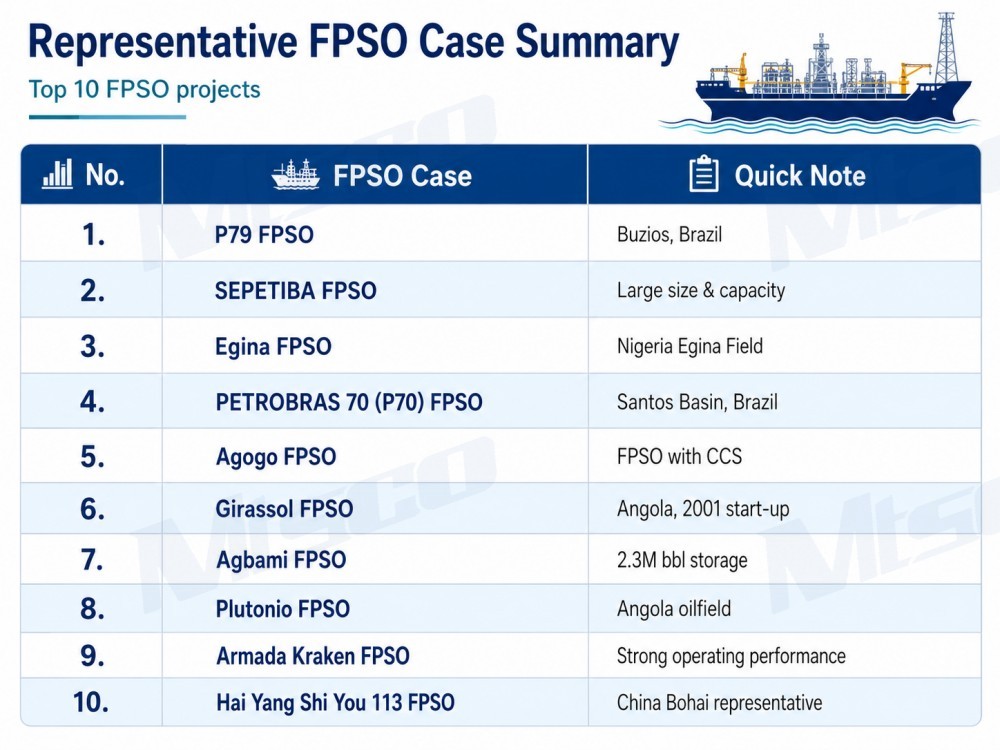
Brazil’s sub-salt oilfields are a region where FPSOs are heavily concentrated; projects such as P-76, P-80, and P-83 are typical examples.
These FPSOs typically feature high processing capacity and large oil storage capacity. Their topsides house a large number of oil and gas processing units, seawater treatment systems, injection systems, and export systems. In terms of materials, stainless steel pipes, duplex steel pipes, pipe fittings, flanges, and instrumentation piping are used in significant quantities.
II. Liza Oil Field, Guyana FPSO
FPSOs such as the Destiny and Prosperity at the Liza Oil Field in Guyana are representative projects in recent deepwater oil and gas development in South America.
Such projects typically employ a subsea production system integrated with the FPSO. Oil and gas enter the FPSO via subsea pipelines and are then processed in the topside module. Since the system operates continuously under high pressure for extended periods, the reliability of pipe connections, flange seals, and control lines is of critical importance.
III. Large-Scale FPSOs in West Africa
The Egina FPSO in Nigeria is one of the flagship projects in deepwater oil and gas development in West Africa.
The topside modules of large FPSOs are complex, featuring a large number of pieces of equipment and dense pipeline layouts. Common pipeline applications include oil and gas processing lines, seawater cooling lines, firewater systems, hydraulic control lines, and chemical injection lines. Depending on the specific medium, materials such as 316L, duplex steel, super duplex steel, or nickel-based alloys may be selected.
IV. North Sea FPSOs and Offshore Projects
North Sea projects are constantly exposed to low temperatures, rough seas, and high operational and maintenance standards, resulting in stricter requirements for material documentation and inspection records.
In such projects, clients typically focus on Material Test Certificates (MTCs), Material Property Reports (PMIs), dimensional inspections, non-destructive testing (NDT), third-party inspections, and packaging and shipping records. For piping systems, selecting the right materials is only the foundation; whether the production process is controllable and whether inspection documentation is complete also significantly impact project delivery.
V. Common Characteristics of FPSO Projects
- Increasing Scale
The processing capacity and oil storage capacity of modern FPSOs continue to increase, with highly integrated topsides and numerous piping and equipment connection points.
- Deepwater Operations
FPSOs are increasingly deployed in deepwater and ultra-deepwater oilfields, placing higher demands on the reliability of the hull structure, mooring systems, subsea production systems, and topsides.
- Stringent Material Requirements
FPSOs are continuously exposed to the marine environment, facing not only salt fog, humid heat, and seawater corrosion but also potentially corrosive components in oil and gas media. Consequently, duplex stainless steel, super duplex stainless steel, and nickel-based alloys are commonly used in critical pipelines.
- High Demand for Supply Chain Coordination
An FPSO project involves a large volume of pipes, pipe fittings, flanges, valves, control cables, and coiled tubing. For EPC contractors, shipyards, and end users, a supplier’s ability to deliver products in accordance with standards, in the correct batches, and by specified milestones directly impacts project progress.
VI. Product Support Provided by Mtsco
Maituo provides seamless pipes, welded pipes, pipe fittings, flanges, control lines, coiled tubing, and other products for offshore energy projects such as FPSOs, with materials ranging from stainless steel to duplex steel and nickel alloys.
In terms of quality control, Metco helps customers mitigate material and delivery risks through raw material inspection, production process traceability, on-site QC, PMI, dimensional inspection, non-destructive testing, and third-party inspection support.
Overall, an FPSO is a complex offshore production system. It places high demands on materials, manufacturing, inspection, and the supply chain. For such projects, a stable supply of diverse product categories and comprehensive quality traceability are essential foundations for ensuring smooth project execution.

 English
 Español
 Русский
 عربي
عربي